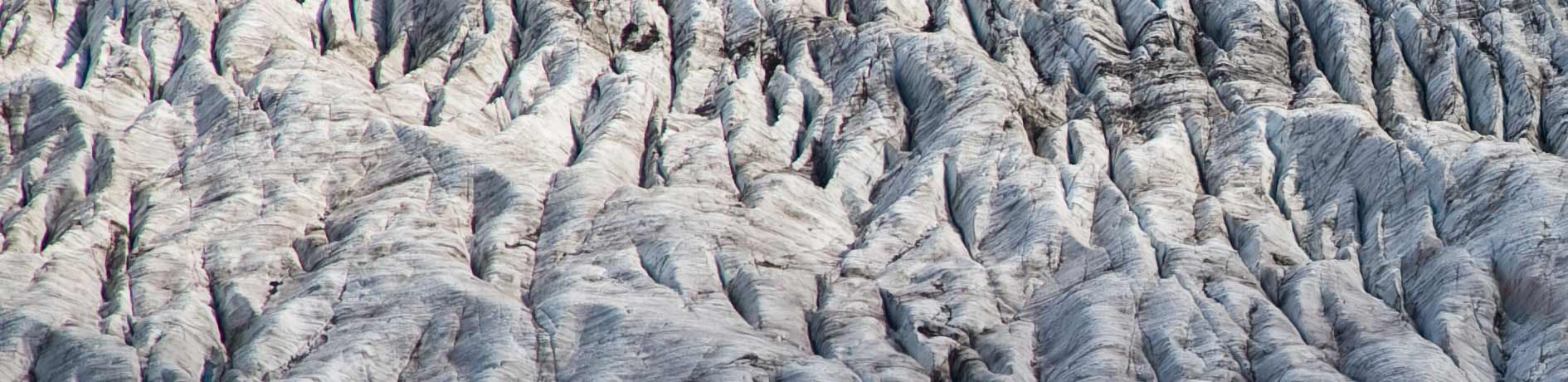
The Cold Regime
Water is a remarkable substance. It is one of very few chemical compounds that change from a liquid to a solid or to vapour within the temperature range found in our daily environment.
Ice caps and glaciers in Iceland
Iceland´s location in a region of maritime climate in the North Atlantic ensures mild temperatures, high levels of snowfall during winter and extensive melting during summer. At present, ice caps and glaciers cover 10% of the country´s total area of 103.000 km2.
“Nature’s best thermometer, perhaps its most sensitive and unambiguous indicator of climate change, is ice.”
A World Without Ice,
Henry Pollack
Henry Pollack
Ice and water – the solid and liquid phases of the chemical compound H2O – can be thought of as partners on a global hydrological see-saw, the ups and downs of which are modulated by planetary-scale climate change. When the planet cools, some water solidifies to ice, and as the planet warms, some ice reverts to water. Throughout the 20th and 21st century, Earth has generally been warming, and ice has been melting at an accelerating pace. On a global scale, the distribution of ice and water plays a critical role in setting the temperature of Earth’s atmosphere, governing major weather patterns, regulating sea level and dramatically impacting agriculture, transportation, commerce and geopolitics.
Ice on Earth can be found in a number of settings: at high elevations in the tropics and mid-latitudes as mountain glaciers and ice fields, and at polar latitudes as sea-ice (frozen sea-water) and large ice sheets, such as the big piles of ice found on Greenland and Antarctica. The loss of ice in all of these settings is accompanied by a number of consequences.
The seasonal melting of mountain glaciers in the Andes in South America and in the Himalaya and Tibetan Plateau of Asia is an important component of agricultural, municipal and domestic water for almost one-quarter of the global population. For millennia, winter snows balanced summer melt to maintain a hydrological equilibrium, but the recent climate warming has upset that equilibrium, as evidenced by retreating glaciers in these areas and elsewhere throughout the world. In Asia, the Himalaya and Tibetan Plateau seasonal ice melt supplies about half the base flow of all the major rivers of south Asia; if the glacial ice disappears, as its present trajectory indicates, the water supply of South Asia will be severely impacted.
In the Arctic there is a seasonal oscillation in the area covered by frozen sea water, expanding in the winter, contracting in the summer. But the extent of residual sea-ice at the end of the Arctic summer has been declining for three decades, with the decline accelerating dramatically in recent years. A new record minimum for Arctic sea ice was set in 2012, and if the decline continues at its present rate, we may see, within just a decade or two, an ice-free Arctic Ocean in the summer for perhaps the first time in human history. The loss of summer sea-ice has led to a warming of the Arctic Ocean, a thawing and destabilization of the permafrost surrounding the Arctic Ocean, and a severe perturbation to Arctic ecosystems that have developed in the presence of sea ice. The consequences for the indigenous peoples of the Arctic center on changes to their food supply and social structure.
On Greenland, summer melting historically has been only at low elevations along the central and southern reaches of the Greenland coast, but it in recent decades it has climbed to higher and more northerly regions. In 2012, summer melting occurred over the entire surface of Greenland. Scores of glaciers on Greenland are slipping faster and faster into the Atlantic, delivering ice to the ocean and thus elevating the global sea level. A loss of only one percent of Greenland’s ice would raise sea level 70 centimeters around the world. In Antarctica, ancient ice shelves – some the size of Belgium, Scotland or France – are disintegrating, removing regional buttresses that for millennia slowed the delivery of massive streams of glacial ice to the sea. Moderate projections of the global sea level at the end of the present century center on about one meter above 19th century levels, impacting around 100 million people who live at sea level around the globe – creating a politically destabilizing tide of climate refugees. The damage to coastal infrastructure will be widespread.
The warming of the global atmosphere also has major implications for an intensification of the global hydrological cycle. A warmer atmosphere evaporates more moisture from the soil which can lead to wide-spread drought in marginal areas, but the atmosphere must return the moisture to the surface through more intense precipitation events. These ever-more-frequent events cause flooding, erosion, interruption of transportation, and overwhelming of sewage and water purification systems. Moreover, the proportions of the seasonal precipitation represented by rain and snow have also been changing as the planet warms, with consequences for the timing of water availability in regional watersheds. Snow is typically stored at high elevations until spring melting delivers it to rivers, in time for agricultural needs. But in a warmer world more precipitation falls as rain and enters rivers prior to when agriculture can utilize it, with adverse implications for food production.
Some might ask – so what? Why should we care about vanishing glaciers and remote polar icecaps? About more frequent droughts and floods? Why does the disappearance of distant ice really matter to a farmer in India, a hydraulic engineer in Tajikistan, an investment banker in London, a tourist hotel manager in Bali, a child in Bangladesh, or a businessman in Beijing? The answer is that, although we have been slow to recognize this, the history and future of our global civilization are inextricably linked to the world’s ice and water.
Prepared by Dr. Henry Pollack for Vox Naturae and UN side event on the Challenge of Declining Ice and Snow held at the United Nations Headquarters on 30 May 2013.
Why ice is important
Materials on glaciers
Glaciers remain the subject of considerable scientific study. Here you’ll find some of the most cutting edge research concerning these harbingers of change and the message they are trying to send us.
Did you know?
Water is the only common substance on earth that becomes less dense as it solidifies. It actually helps to isolate from cold, and protects life in the waters that it covers.
In a time of increasing freshwater scarcity, more than one quarter of the world’s population depends on glaciers and snow for their drinking water, agriculture, and energy production.
Ice acts as a heat shield for our planet, keeping it at the perfect temperature for the human race to flourish.
Ice teaches us about our climate. It has taught us that in the last 2.5 million years there have been 20 glacial periods, lasting about 100,000 years each. We are currently living in a short interglacial period.